


Driving Forces of Work Motivation: A Case Study of Shopee, Vietnam
- University of Social Sciences and Humanities, Vietnam National University HCM
- University of Economics and Law, VNUHCM
Abstract
Work motivation is a crucial issue that covers various areas of management and leadership, including organisational culture, working conditions, and performance management. The purpose of this study is to examine how the variable of work motivation, as a set of psychological components, drives the initiation, direction, intensity, and persistence of individual behaviours in an organization; employees with high work motivation help a company gain significant competitive advantages and leverage organizational effectiveness and efficiency. Kovach’s Ten Motivational Factors and the Employee Motivation Scale, developed by Tran Kim Dung and Nguyen Ngoc Lan Vy, were used as the research methodology to examine the practices of work motivation at a multinational e-commerce firm Shopee Vietnam. The research results show that the employees' work motivation at Shopee Vietnam is affected by the factors of working conditions, corporate brand and culture, suitable jobs, and income and benefits. Based on the research results, the preliminary solutions for enhancing employees’ work motivation to optimize human capability and organizational performance are also proposed.
INTRODUCTION
Human capital has been recognized as one of the key success factors in today’s business environment, and there is a correlation between organizational capacity, employee productivity or performance, and work motivation 1. Work motivation is a crucial issue in the realm of management, both practically and theoretically, that covers various areas of management and leadership, including employee motivation and performance, managerial ethics, decision-making, and the transformation capability of the organization. Work motivation, through the lens of organizational behavior, is commonly characterized as a set of psychological processes that drive action initiation, direction, intensity, and persistence 2; 3. Work motivation encourages people to work harder and cheerfully to add value to organisational development and growth. Employees with a prominent level of work motivation often have positive psychological capital and dedication that lead to high organizational efficiency.
Shopee is a multinational e-commerce operating in different countries in the Asia Pacific region, including Thailand, Malaysia, and Vietnam. The recent worldwide digitalization of the e-commerce business has dramatically affected Shopee Vietnam, particularly the impact of technology on the company's human resources management, the nature of work, and the employee’s work motivation and performance. Shopee Vietnam has been facing serious workforce problems of an overwhelmed workload, high turnover, employees’ low motivation, and low satisfaction. The study used the quantitative methods: meta-analysis for analyzing the relevant data collected from the focus group survey and various sources provided by the human resources department, and the statistical analysis with the SPSS software to evaluate the measurement scales of work motivation and identify the key factors that affect the work motivation and job satisfaction of employees at Shopee Vietnam.
The findings from this research help Shopee Vietnam have an inclusive review of its employees’ work motivation and generate some initiatives for improvement. The results from this research also provide some concise insights into managerial implications within the specific context of Vietnamese culture and diverse perceptions of work motivation and satisfaction that help managers and leaders in multinational companies in Vietnam effectively implement a strategic human resources management that fosters a working environment and culture enabling all the employees’ personal and career development.
The paper structure emphasizes the theoretical framework and hypothesis development on the fundamental concept of work motivation and theories of work motivation. Some crucial parts of this paper such as the research model, research methodology, data collecting and analyzing method, research results and discussion, and conclusion focus on examining the research hypothesis on the employees’ work motivation and personal growth.
THEORETICAL FRAMEWORK AND HYPOTHESIS DEVELOPMENT
Theoretical framework
A tremendous number of studies on work motivation have been conducted for decades but what are the key factors that affect the employee’s work motivation and how to enhance work motivation in the workplace are still the critical issues that need to be literately analyzed by exceptionally reliable measurement tools and techniques. Mastering the relevant theories of work motivation through the lens of psychological capital is the first stage in this complex research journey.
The fundamental concept of work motivation
The term work motivation is defined in a variety of ways, but it is believed to be the force that drives individuals to work hard and commit themselves to attain their objectives. Motivation is defined simply as the degree to which a person desires to attain and chooses to engage in a particular action, the willingness to put significant effort toward organizational goals in exchange for the fulfillment of a personal need 4. According to Nguyen and Nguyen 5, motivation refers to both internal and external efforts that have the impact of instilling passion and perseverance in the pursuit of a desired goal, and work motivation is the willingness to invest the time and effort required to meet personal and organizational objectives, an internal drive that encourages people to work for a shared objective based on an individual's underlying conscious and unconscious desires. A highly motivated employee is someone who devotes their time, energy, and spirit to accomplishing tasks and meeting goals 6.
Motivation is the internal force that pushes people's activities, leads their conduct, and enhances their dedication to achieving their goals. Psychologically, managers who have more time to communicate with their staff gain a better understanding of employees’ motivation, and what relevant factors inspire employees to willingly sacrifice their time, energy, and efforts for the firm.The company must effectively identify these factors to effectively empower their employees to proactively collaborate and achieve the organizational shared vision and goals.
Theories of work motivation
The term “needs” might be considered the root of work motivation studies. The most popular Human Needs Hierarchy of Maslow 7 highlights five levels of human needs: physiological, safety, love, esteem, and self-actualization. Maslow’s need theory helps managers understand how the employee’s motivation or driving force is formed, and how they can motivate their employees based on the low-high level of needs or expectations. Alderfer’sERG model emphasizes the importance of people’s desires – an individual can move up and down the hierarchy but be content with their current level of need satisfaction, and managers who can identify the employee’s status or desire can concentrate on satisfying workers' immediate requirements 8. Similarly, McClelland's Three Needs Theory9 describes that people are motivated by the need for accomplishment, alliance, and power. People with a high desire for success are those who are always seeking new challenges and striving for achievement with responsibility, ambitious goals, and, most importantly, autonomy; while people with affiliation need stem from a desire for acceptance, affection, and companionship, and people with power need who often have the desire to exert influence or control over others, as well as influence over others' working conditions.
Other scholars such as Herzberg, Adams, and Vroom examine work motivation through the employee’s “expectation” within a more complex view of the whole organization within external and internal contexts. Herzberg’s Two-Factor Theory, motivation factors and hygiene or demotivation factors, discover motivation factors in the complex work environment, personal recognition, opportunity, participation or engagement, and organizational citizenship 10. If motivational factors are handled correctly, that would drive the employees to work more enthusiastically with a high level of employee satisfaction; on the contrary, the employees’ dissatisfaction occurs. This theory emphasizes that motivating employees necessitates addressing both motivation and hygiene issues factors at the same time, and managers cannot expect employees to be satisfied merely by removing the sources of dissatisfaction. Adams' Equity Theory of Motivation describes that individuals are driven and feel fair when they view their income to be equal to that of others who make the same contribution 11. Hence, work motivation can be measured by the employees’ satisfaction with their remuneration, recognition, and promotion opportunities. Vroom's Expectancy Theoryhighlights the critical variable of expectation and another variable of “human behaviour” – work motivation is also influenced by people's “perceptions” of their future aspirations 12. Since this theory is based on employee perception, it can happen that working at the same company and in the same position, one person is motivated, and the other is not because their understanding of the above concepts is different. Managers should establish awareness among workers that drives people toward the organizational goals.
Other studies on work motivation such as Hackman and Oldham's Job Characteristics Model 13 and Kovach's Ten Factor Model 14 examine work motivation through the “characteristics” of the individual and the job or work. Hackman and Oldham argue that work itself has some essential characteristics, and the employees are motivated to increase their productivity depending on the work itself which includes skill variety, task significance, autonomy, and feedback 13. Hence, different jobs motivate employees in diverse ways. Employees have a high level of work motivation when they have physical and psychological development opportunities, job meaningfulness, autonomy, and positive collaboration in the workplace. Kovach provides ten factors of employee motivation: interesting work, appreciation for accomplishments, the feeling of being in on things, job security, good wages, opportunities for advancement and development, good working conditions, personal loyalty, tactful discipline, and sympathetic help with personal problems 14. Kovach’s Ten-Factor model has been widely disseminated and tested by many researchers to discover the factors affecting work motivation for employees in many different industries to be discussed further in the following sections of this paper.
Typical studies on work motivation
Simons and Enz15 conducted a study on work motivation with a focus group survey of 278 workers from 10 different hotels in the United States and Canada to re-examine the validity of Kovach's work motivation theory. The survey used Kovach's Ten-Factor Motivation model, and the participants were asked to rate the importance of their motivating reasons or factors on a scale of 1 to 10, with 1 being the most significant and 10 being the least important. This research proposed the 10 elements that affected the employees’ work motivation: (1) good wages, (2) job security, (3) opportunities for advancement and development, (4) good working conditions, (5) interesting work, (6) appreciation for accomplishments, (7) personal loyalty to employees, (8) feeling of being in on things, (9) tactful discipline, and (10) sympathetic help with personal problems.Another study conducted by Lindner16 tested the validity of Kovach's Ten-Factor Motivation model by examining the motivation of 25 workers from two different campuses of Ohio State University. The participants were asked to rate 10 work motivation-related elements on a scale of 1 to 10, with 1 being the most significant and 10 being the least important. This study provided a different result from Simons and Enz’s15 study: (1) interesting work, (2) good wages, (3) full appreciation of work done, (4) job security, (5) good working conditions, (6) promotions and growth in the organization, (7) feeling of being in on things, (8) personal loyalty to employees, (9) tactful discipline, and (10) sympathetic help with personal problems.In the Asia Pacific region, an in-depth study named “Herzberg's motivation-hygiene theory and job satisfaction in the Malaysian retail sector” conducted by Teck-Hong and Waheed 17 proved that the element of (1) working conditions was identified as the most crucial factor affecting employees’ work motivation; other elements of (2) recognition, (3) company policy, and (4) salary which were viewed less important respectively.
In Vietnam, many studies were also conducted to examine the factors affecting work motivation. A study conducted by Le Thi Thuy Uyen 18 used Kovach's Ten Factor Model and conducted a survey sample of 482 full-time employees in Ho Chi Minh City, Binh Duong,Dong Nai, Da Nang, and Kontum to identify and affirm the 8 factors affecting employees satisfaction: (1) high salary, (2) sustainable work, (3) good working conditions, (4) opportunities for career advancement and development, (5) interesting work, (6) having autonomy in work, (7) being fully recognized in work, and (8) leadership of the company. Another study on 445 full-time employees in Ho Chi Minh City conducted by Tran Kim Dung and Nguyen Ngoc Lan Vy 19, which also adopted Kovach's ten motivational factors model (1987), identified 4 groups of motivational factors arranged in the following order of importance: (1) political policies, reasonable remuneration, (2) company's brand, (3) work relations, and (4) suitable job.Another similar study conducted by Le Thi Bich Phung and Tran Kim Dung 20 clarified the 6 motivation-related elements of a motivation scale: (1) work, (2) brand and company culture, (3) direct leaders, (4) colleagues, (5) remuneration policy, and (6) income and benefits.
A tremendous number of studies conducted by scholars in Vietnam and worldwide have attempted to verify the key motivation-related elements and the importance of each element. These literature reviews are the foundation that forms the research methodology and techniques for this research.
Research model and hypothesis development
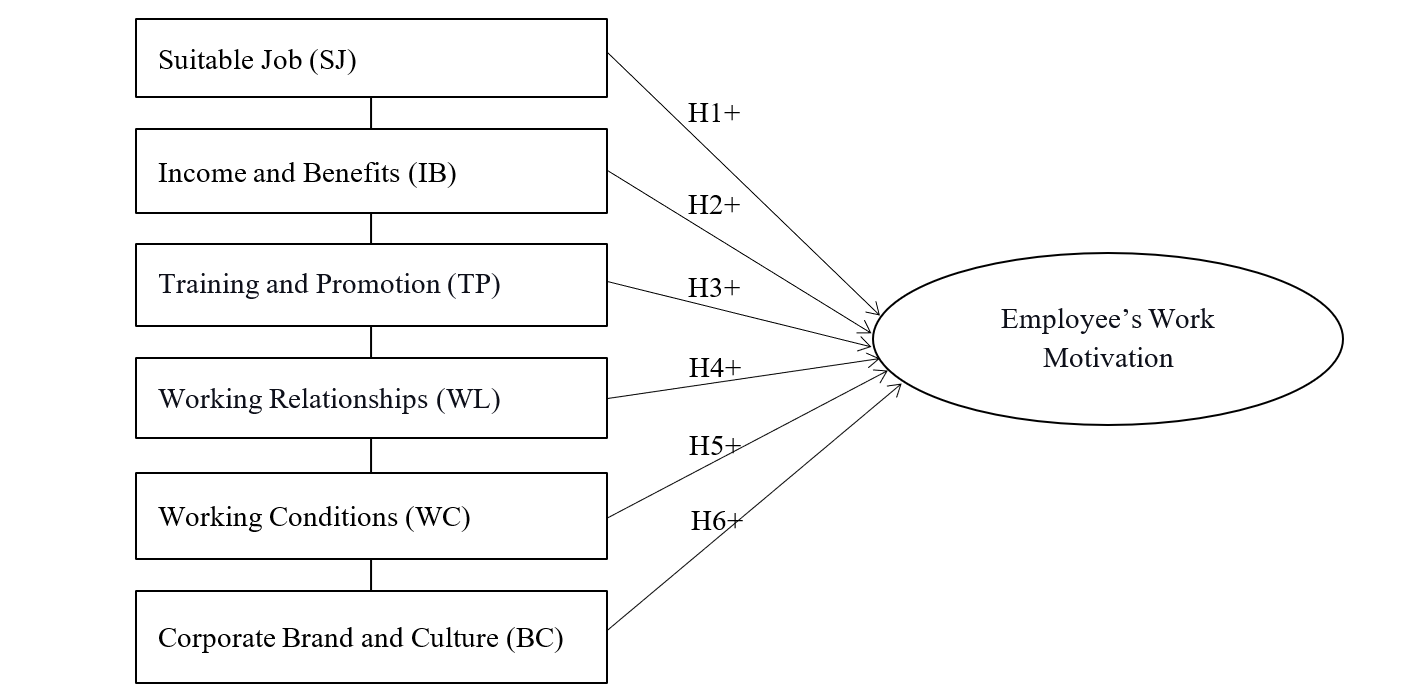
Proposed research model [Source: Authors’ compilation]
Suitable Job (SJ)
The variable "suitable job" refers to all aspects of the job, such as job design, job nature, importance, and potential for the career development of the job, etc., as well as employees' attitudes, perceptions, and efforts. The nature of the job has a considerable influence on an employee's work motivation 21. Employees can put forth effort at work not only for monetary gain (e.g., getting paid) but also to meet their basic psychological needs 22.The employees need to be able to accomplish a task that is appropriate for their abilities; the diversity, creativity, and difficulties of suitable employment represent the diversity, creativity, and problems of the profession, as well as the chances to use and enhance individual strengths and capacities 14.If the work is interesting and challenging, employees understand the importance of the work and receive feedback from it, then the employees would feel interested and enthusiastic about working more 13. Similarly, employees need to realize that the outcome of their work depends on their initiatives, efforts, and decisions, they might have a high level of responsibility and effort for their work and be more motivated and interested if the job is designed to ensure the following factors: many skills, employees' ability to grasp the job, and the opportunity to develop themselves 12. Bellingham23 affirms that challenging jobs that match the employees’ abilities may create satisfaction for the employees. Following that, the study sets a hypothesis on the impact of a suitable job on work motivation as follows:
H1: A suitable job has a positive impact on work motivation at Shopee Vietnam.
Income and benefits (IB)
The variable “income and benefits” or rewards refers to the incomes and all financial and non-financial benefits. Income is payments to employees periodically based on the results of their work in the form of products, time salary, or package salary. The income in this study is understood as all income from the company that employees receive, including basic salary, bonus, and allowance. Income is always the most important motivation to stimulate people to work enthusiastically and positively. Benefits are indirect remuneration paid in the form of life support to employees. Benefits show the concern of the company for the lives of employees. Benefits include travel, periodic health checks, social insurance, health insurance, retirement, vacation, gifts for employees on birthdays, etc. According to Artz 24, benefits are particularly important in helping employees ensure a minimum standard of living and improve working capacity. Kovach’s model 14 and Islam-Ismail25 explained the term benefits as a high salary, while Velnampy 26, Le Thi Bich Phung and Tran Kim Dung20 considered it as income welfare and welfare policy, respectively. These factors are inherited, and the author proposes a hypothesis as follows:
H2: Income and benefits have a positive impact on work motivation at Shopee Vietnam.
Training and promotion (TP)
The variable “training and promotion” or career development opportunity includes the opportunities of training and promotion as a crucial element of employee’s work motivation. Training programs help employees acquire the necessary knowledge and skills to perform their current jobs and develop their future work 14. This factor represents the greatest need, which is to be respected and to assert oneself. In most companies, employees can be promoted to higher positions in the corporation depending on their future inclinations, increasing their compensation, work capacity, and proven credentials; and the promotion offers opportunities for personal growth, greater responsibility, and higher social status 7. Herzberg's theory suggests that jobs with achievement and promotion affect employee satisfaction, and the lack of promotion opportunities is one of the factors that have a direct negative relationship with employees of the company 10. In this study, we propose that training and promotion be combined into one factor, which is "training and promotion". Therefore, we set a hypothesis about the influence of training and promotion on work motivation as follows:
H3: Training and promotion have a positive impact on work motivation at Shopee Vietnam.
Workingrelationships (WL)
The working relationship is the relationship between employees in the company with leaders and colleagues in the company. Leadership is a process by which one person influences others to achieve a certain goal and, at the same time, directs the organization toward close cohesion, creating trust and motivation for employees to develop their capabilities. According to Thiedke 27, the relationship between superiors and subordinates includes ease of communication with superiors, support, and care when necessary, and fair treatment of subordinates; the employees' work motivation depends much on what managers show. Managers' actions directly or indirectly affect employees' work motivation in both positive and negative aspects. Poor communication between leaders and employees reduces work motivation, and when employees see that the organization does not care about them, they start to not be interested in work 28. The employees find a new job when their current manager fails to develop employees, and the employees who receive informational support from their supervisors are more likely to feel satisfied 29. Employees enhance their job efficiency if they operate in an environment that fosters excitement, solidarity, mutual aid, experience sharing, and collaboration among coworkers 30; and the employees reach their best performance when their colleagues are dedicated and enthusiastic about their work 23.Following that, the study sets a hypothesis about the impact of leaders on work motivation as follows:
H4: Working relationships have a positive impact on work motivation at Shopee Vietnam.
Working Conditions (WC)
Facilities, types of machinery, equipment, cleanliness, and support for processes are all examples of working conditions. An employee must have the needed competence and satisfy the physical requirements to perform successfully at their assigned work. The higher the labor productivity and the freeing of physical labor 7, the better the working circumstances indicate a decent working environment 14. The employees would be able to perform more simply and efficiently if they had healthy working conditions, both physically and psychologically. Working circumstances are the most significant element impacting workplace motivation 17, and employees’ discontent occurs if firms are unable to create a better working environment 10. Referring to previous studies, temporarily hypothesizing the relationship between working conditions and shop employees’ motivation:
H5: Working conditions have a positive impact on work motivation at Shopee Vietnam.
Corporate brand and culture(BC)
When a company's brand and image make an impression, it has a beneficial impact on attracting, keeping, and inspiring people. When employees work for a renowned, well-known firm, they feel proud, and they are honored to be a part of that group and hope to stay for a long time. The employees, on the other hand, believe in a bright future when they work for the organization; the employees are more engaged with the firm when they have faith in the company's high-quality products and services. This is an important aspect of enhancing employee motivation and loyalty, and the corporate culture has a positive relationship with employees 31; Le Thi Bich Phung and Tran Kim Dung20 also emphasized the crucial roles of company culture and brand in their suggested model. Inheriting these studies, we propose the "Brand and corporate culture" hypothesis as below:
H6: Brand and corporate culture have a positive impact on work motivation at Shopee Vietnam.
RESEARCH METHODOLOGY
Preliminary research
A preliminary questionnaire (draft scale) was built, including a part asking participants to discuss whether they agreed or disagreed with the components in the list. Then, we conducted a direct group discussion with 9 people, including conducting direct interviews with managers, and colleagues from different departments to adjust and supplement the model. Through the preliminary research, all 9 surveyed employees agree with the proposed model, including the 6 factors and no additional factors. The preliminary research results are the basis for designing questionnaires for official research, keeping the research model of 6 factors affecting the work motivation of Shopee Vietnam employees.
Measurements of constructions. The author builds a research model with the dependent variable being the work motivation and six independent variables: suitable job, income and benefits, training and promotion, working relationships, brand and company culture, and working conditions. The official survey questionnaire consists of the 30 variables and a 5-point Likert scale with the 5 levels from "strongly disagree" to "strongly agree" to assess the level of agreement/disagreement of the survey subjects or variables.
The construct of work motivation is measured through the employee self-reports, and the respondents rate statements such as "I am inspired in my work" and "I work with my best attitude" on a scale of 1 (strongly disagree) to 5 (strongly agree), which provides a quantifiable understanding of the level of intrinsic and extrinsic motivation among employees. The construct of a suitable job is measured through the survey items including "My job is suitable for my personality and abilities" and "I have autonomy in my current role.", with a focus on the employees' perceptions of how well their job matches their skills, job security, and the extent to which they have control over their tasks. The income and benefits construct is measured using survey items like "My current salary is equivalent to my ability and contribution" and "The company’s welfare policy shows its care for employees.", in which the higher scores indicate the higher satisfaction with income and benefits. The construct of training and promotion is measured by the employee responses to statements such as "I have opportunities for job training and career development" and "The company’s promotion policy is clear and fair." indicating the availability and perceived fairness of training programs and promotion pathways.
Other constructs, the working relationships construct is measured using the items like "I often receive support, guidance, and advice from my supervisors when needed" and "My colleagues are very friendly and open.", where a higher score represents a better perception of working relationships. The survey items like "The company provides adequate equipment and tools for employees" and "The company guarantees occupational health and safety" are used to measure the construct of working conditions, in which the higher scores indicate the more favourable working conditions. The construct of corporate brand and culture is measured through the items including "I am proud of my company's brand" and "I feel I am a fit for my company’s culture.", capturing the level of employee identification with the company and its values.
Data collecting method
Secondary data. The secondary data are collected, during the period from 2019 to 2022, from many diverse sources of information such as books, textbooks related to business administration, articles, scientific conferences, published research works, master's theses, national and international researchers, and internet data on issues related to this research paper.
Primary data. We sent a questionnaire (27 questions covering 7 relevant variables) via email to Shopee employees, and they can fill out their answers through a Google Form. The sample size applied in the study must be based on the requirements of the exploratory factor analysis (EFA) and multivariate regression; and choosing the appropriate research observation size for the EFA analysis, the minimum observation size is N>5*x (with x being the total number of observed variables) 32. Thus, the minimum sample size in this study is 27*5 = 135. However, to increase the reliability of the data we decided on a sample size of 215 samples. There were the 15 unsatisfied respondents eliminated, and the valid data of 200 respondents was classified by gender, age, seniority, education level, and income level by the SPSS software before further analysis.
Data analyzing method
Cronbach's Alpha Reliability Analysis. Using Cronbach's Alpha reliability coefficient technique to test the reliability of each factor's scales. Cronbach's Alpha coefficient measures the degree of correlation between the variables in the questionnaire, allowing us to quantify both the change in each variable and the correlation between them. By deleting the inaccurate variables from the research model, the analyst can limit the number of garbage variables in the model. The unsuitable variables are removed if the correlation coefficient of the total variable (Corrected Item - Total Correlation). In most cases, a scale with Cronbach's Alpha ranging from 0.7 to 0.8 can be used 33. The greater the Cronbach's Alpha, the better, in theory (the more reliable the scale).
Exploratory Factor Analysis (EFA). Test the correlation between the measured variables by the Barlett test with a significance level of 5% 32. KMO test > 0.5 to test the correlation, the method of extracting coefficients used is the Principal Components and Varimax rotation 34. The criteria for selecting the number of factors: Based on the Eigenvalues index > 1 and available theoretical models. Testing the fit of the EFA model with the survey data: The total variance extracted (Cumulative %) > 50% 34. The convergence value test: To achieve the discriminant validity, the variables with factor loading must be > 0.5; the variables with factor loading < 0.5 to be excluded 34. The correlation analysis: There are two options to evaluate the correlation level in linear regression analysis: through the scatter plot or Pearson correlation coefficient. The closer the Pearson correlation coefficient approaches 1, the more closely the two variables are correlated 35.
Linear Regression Analysis. The linear regression approach examines the relationship between one or more independent variables and a quantitative dependent variable, and it is a trendy way to see how well a model fits. The findings of linear regression analysis are used to estimate, anticipate, and propose management implications. Then, using the method of ordinary least squares (OLS), a multivariate linear regression analysis was conducted, with the dependent variable being general working motivation and the independent variable being suitable jobs, income and benefits, leaders, colleagues, working conditions, training and promotion, and company culture.
Checking the adjusted R square coefficient (Adjusted R Square) to assess the model's goodness of fit; check the Sig values less than 0.05 and the F coefficient in the ANOVA table to validate the regression model's fit with the sample population. The F test is used to evaluate the overall linear regression model's fit. The regression model's fit is further tested using the F-test for the fluctuation of deviation owing to regression and residual deviation. The hypothesis H0 of the F-test is that the model's regression coefficients are all equal to 0. We can infer that the regression model is appropriate if we reject this hypothesis.Evaluate the strength or weakness of the variables to the level of importance through the coefficients Beta Coefficient 34. The linear regression has the form:
Yi= β0 + β1Xi+ β2X2+ β3X3+ … + β6X6 + ε.
Where Yi: Dependent variable; Xi: independent variable i;β0: Regression constant; βp: partial regression coefficient; and ε: random error.
RESEARCH RESULTS AND DISCUSSION
The research samples were selected by the conventional method, with a valid sample size of n = 200 which is classified into gender, age, seniority, education level, and income level. The gender gap ratio between 108 females (54%) and 92 males (46%) is not too large in this group; most of the employees are quite young (35% from 23 to 30 age) and suitable for jobs that require dynamism and creativity (See Table 1).
The sum of the variances explained by the independent variables
|
Component |
Initial Eigenvalues |
Extraction Sums of Squared Loadings |
Rotation Sums of Squared Loadings | ||||||
|
Total |
% of Variance |
Cumulative % |
Total |
% of Variance |
Cumulative % |
Total |
% of Variance |
Cumulative % | |
|
1 |
5.160 |
21.500 |
21.500 |
5.160 |
21.500 |
21.500 |
2.988 |
12.448 |
12.448 |
|
2 |
3.826 |
15.942 |
37.442 |
3.826 |
15.942 |
37.442 |
2.705 |
11.270 |
23.718 |
|
3 |
1.769 |
7.372 |
44.814 |
1.769 |
7.372 |
44.814 |
2.594 |
10.808 |
34.526 |
|
4 |
1.669 |
6.953 |
51.767 |
1.669 |
6.953 |
51.767 |
2.503 |
10.427 |
44.954 |
|
5 |
1.540 |
6.418 |
58.185 |
1.540 |
6.418 |
58.185 |
2.459 |
10.246 |
55.200 |
|
6 |
1.279 |
5.328 |
63.513 |
1.279 |
5.328 |
63.513 |
1.995 |
8.313 |
63.513 |
|
7 |
.956 |
3.985 |
67.498 | ||||||
|
8 |
.822 |
3.425 |
70.923 | ||||||
|
9 |
.733 |
3.052 |
73.976 | ||||||
|
10 |
.687 |
2.861 |
76.837 | ||||||
|
11 |
.647 |
2.697 |
79.534 | ||||||
|
12 |
.609 |
2.538 |
82.072 | ||||||
|
13 |
.544 |
2.265 |
84.337 | ||||||
|
14 |
.520 |
2.167 |
86.503 | ||||||
|
15 |
.475 |
1.978 |
88.482 | ||||||
|
16 |
.429 |
1.789 |
90.270 | ||||||
|
17 |
.377 |
1.573 |
91.843 | ||||||
|
18 |
.365 |
1.520 |
93.363 | ||||||
|
19 |
.354 |
1.474 |
94.837 | ||||||
|
20 |
.323 |
1.344 |
96.181 | ||||||
|
21 |
.271 |
1.130 |
97.311 | ||||||
|
22 |
.243 |
1.014 |
98.325 | ||||||
|
23 |
.221 |
.923 |
99.247 | ||||||
|
24 |
.181 |
.753 |
100.000 | ||||||
The total variance explained is 63.513% > 50%, showing that the 6 discovered factors explain 63.513% of the variance of the data set. Thus, these the 6 factors can be used in the data analysis in the next step (See Table 2).
The result of the independent variable factor rotation matrix
|
1 |
2 |
3 |
4 |
5 |
6 | |
|
IB4 |
.798 | |||||
|
IB3 |
.769 | |||||
|
IB5 |
.727 | |||||
|
IB1 |
.684 | |||||
|
IB2 |
.676 | |||||
|
WL3 |
.886 | |||||
|
WL2 |
.814 | |||||
|
WL4 |
.722 | |||||
|
WL1 |
.705 | |||||
|
BC3 |
.822 | |||||
|
BC2 |
.796 | |||||
|
BC4 |
.698 | |||||
|
BC1 |
.694 | |||||
|
WC1 |
.760 | |||||
|
WC3 |
.735 | |||||
|
WC2 |
.733 | |||||
|
WC4 |
.699 | |||||
|
TP2 |
.826 | |||||
|
TP1 |
.754 | |||||
|
TP3 |
.724 | |||||
|
TP4 |
.655 | |||||
|
SJ1 |
.781 | |||||
|
SJ2 |
.759 | |||||
|
SJ3 |
.735 |
Thus, when rotating the factor, the results of the factor pivoted table show that there are the 6 factors drawn. The factors are all convergent and no new combinations appear. Therefore, the research model remains the same.
Correlations
|
SJ |
IB |
TP |
WL |
WC |
BC |
EW | ||
|
SJ |
Pearson Correlation |
1 |
.327** |
.062 |
.074 |
.316** |
.302** |
.432** |
|
Sig. (2-tailed) |
.000 |
.383 |
.298 |
.000 |
.000 |
.000 | ||
|
N |
200 |
200 |
200 |
200 |
200 |
200 |
200 | |
|
IB |
Pearson Correlation |
.327** |
1 |
-.063 |
-.017 |
.385** |
.388** |
.496** |
|
Sig. (2-tailed) |
.000 |
.376 |
.814 |
.000 |
.000 |
.000 | ||
|
N |
200 |
200 |
200 |
200 |
200 |
200 |
200 | |
|
TP |
Pearson Correlation |
.062 |
-.063 |
1 |
.488** |
-.036 |
-.127 |
-.119 |
|
Sig. (2-tailed) |
.383 |
.376 |
.000 |
.608 |
.072 |
.093 | ||
|
N |
200 |
200 |
200 |
200 |
200 |
200 |
200 | |
|
WL |
Pearson Correlation |
.074 |
-.017 |
.488** |
1 |
-.013 |
-.001 |
-.024 |
|
Sig. (2-tailed) |
.298 |
.814 |
.000 |
.856 |
.984 |
.737 | ||
|
N |
200 |
200 |
200 |
200 |
200 |
200 |
200 | |
|
WC |
Pearson Correlation |
.316** |
.385** |
-.036 |
-.013 |
1 |
.366** |
.660** |
|
Sig. (2-tailed) |
.000 |
.000 |
.608 |
.856 |
.000 |
.000 | ||
|
N |
200 |
200 |
200 |
200 |
200 |
200 |
200 | |
|
BC |
Pearson Correlation |
.302** |
.388** |
-.127 |
-.001 |
.366** |
1 |
.597** |
|
Sig. (2-tailed) |
.000 |
.000 |
.072 |
.984 |
.000 |
.000 | ||
|
N |
200 |
200 |
200 |
200 |
200 |
200 |
200 | |
|
EW |
Pearson Correlation |
.432** |
.496** |
-.119 |
-.024 |
.660** |
.597** |
1 |
|
Sig. (2-tailed) |
.000 |
.000 |
.093 |
.737 |
.000 |
.000 | ||
|
N |
200 |
200 |
200 |
200 |
200 |
200 |
200 |
hows the correlation between the independent and dependent variables is Sig < 0.01, showing that there is a strong correlation between the independent variable and the dependent variable.Besides, the correlation between mutually independent variables has Sig. > 0.01 shows that the independent variables are not correlated with each other (See Table 4).
Coefficients
|
Hypothesis |
Normalized regression coefficient |
Sig value |
Inspection results |
|
Hypothesis H1 |
.152 |
.002 |
Accept |
|
Hypothesis H2 |
.150 |
.004 |
Accept |
|
Hypothesis H3 |
-.064 |
.213 |
Does not accept |
|
Hypothesis H4 |
.005 |
.929 |
Does not accept |
|
Hypothesis H5 |
.432 |
.000 |
Accept |
|
Hypothesis H6 |
.327 |
.000 |
Accept |
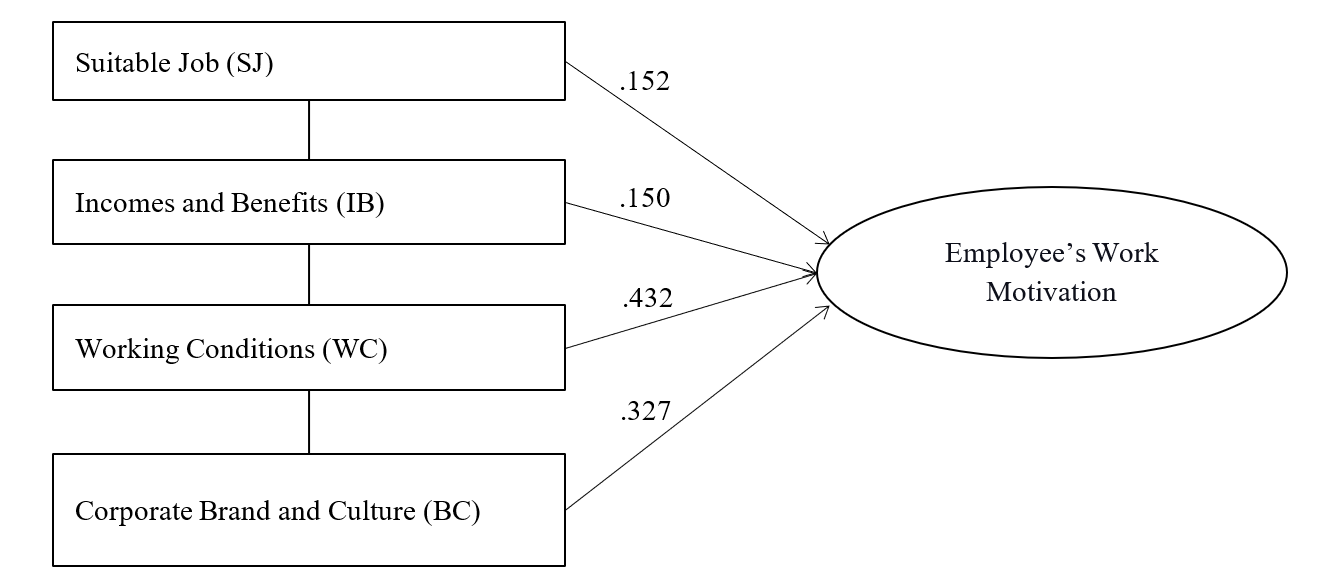
Based on the above summary table, the four research hypotheses are accepted.
For the factor “Suitable job”, the normalized regression coefficient = 0.152, the value sig. (p-value) less than 0.05 is enough basis to conclude that this regression coefficient is significant in the model, in other words, the regression coefficient has a positive influence (positive beta) on the dependent variable “Employees' work motivation”. Therefore, the hypothesis H1 is accepted. For the factor “Incomes and benefits”, the normalized regression coefficient = 0.150, the sig value. (p-value) less than 0.05 is enough basis to conclude that this regression coefficient is significant in the model, in other words, the regression coefficient has a positive influence (positive beta) on the dependent variable “Employees' work motivation”. Therefore, the hypothesis H2 is accepted. For the factor “Training and promotion”, the normalized regression coefficient = -0.064, the sig value. (p-value) greater than 0.05 can conclude that this regression coefficient is not significant in the model. Therefore, the hypothesis H3 is not accepted. It is consistent with the statistics describing the variable observation “Training and promotion” that the training policy at Shopee Vietnam is not clear and has many limitations, while the promotion policy of the company stipulates the conditions for promotion.
For the factor “Work relationship”, the standardized regression coefficient = 0.005, the value sig. (p-value) greater than 0.05 can conclude that this regression coefficient is not significant in the model. Therefore, the hypothesis H4 is not accepted. It is consistent with the statistics describing the variable observation “Work relationship” that the employees at Shopee Vietnam are highly satisfied with the current workplace relationship. For the factor “Working conditions”, the normalized regression coefficient = 0.432, the value sig. (p-value) less than 0.05 is enough basis to conclude that this regression coefficient is significant in the model, in other words, the regression coefficient has a positive influence (positive beta) on the dependent variable “Employees' work motivation”. Therefore, the hypothesis H5 is accepted. For the factor “Brand and corporate culture”, the normalized regression coefficient = 0.327, the sig value. (p-value) less than 0.05 is enough basis to conclude that this regression coefficient is significant in the model, in other words, the regression coefficient has a positive influence (positive beta) on the dependent variabler “Employees' work motivation”. Therefore, the hypothesis H6 is accepted.
Through the results of multiple linear regression analysis, the original research model was adjusted in the following Figure 1.
Research model results [Source: Results of data analysis]
The research results presented the statistically significant correlations between the four elements of work motivation: working environment, corporate brand and culture, suitable job, income, and benefit, and with the descending order from the strongest influential factor to the least influential factor. Firstly, the working environment, with the coefficient ß = 0.432, is the strongest influential factor that has a significant impact on the employee motivation. In the study of Charles and Marshall 36, a good working environment is assessed as the top priority of hotel staff in the Caribbean. The result is also consistent with Teck-Hong and Waheed’s conclusion that the working conditions, or the environment are identified as the most crucial factors affecting employees’ work motivation 17. Therefore, the more employees have a good working environment, the more motivated and willing to work. The second-ranked factor, the “corporate brand, and culture” with the coefficient ß = 0.327 also significantly influences the employee motivation, consistent with the research result of Tran Kim Dung and Nguyen Ngoc Lan Vy 19. In Vietnam, only large companies focus on their branding and corporate culture, and the employees who work for firms with reputations or “big brands” often feel proud of their jobs. These companies often offer incredibly good policies on salary, bonuses, welfare, remuneration policy, career development opportunities, and a holding environment that fosters high performance.
The third-ranked factor, the “suitable job” with the coefficient ß = 0.152, includes a variety of job-related elements such as job design and job arrangement, the nature and position of the job, the possibility of future career development, and the employee's capacity-based job. Comparing the research results with the results of Nguyen Thuy Thu Trang 34, employees usually attach the importance to the factor of “suitable job”, including work interests, recognition of work achievements, and work engagement. Lindner16 also affirmed that one of the motivating factors for employees is interesting work or work interest. It seems that with the fast-growing economy in Vietnam, all employees have been more interested in the opportunity for career development. This factor of “suitable job” proves that employees are more motivated and excited if their jobs are designed to achieve their desired objectives such as multiple skills enhancement, simplification and accomplishment, and opportunities for personal development. Finally, the factor of “income and benefits” with the coefficient ß= .150, is ranked as the least influential factor among these four factors that affect the employees’ work motivation. This research result is consistent with a study conducted by Nguyen Thuy Thu Trang 34 which concluded that the element of “income and benefits” has a direct influence on the employees' work and social lives. In other words, when the employees are not satisfied with their compensation or rewards, they may seek a better working environment with better remuneration. Overall, the findings from this research with a sample N = 200, and Cronbach’s Alpha reliability coefficient and EFA analysis provided comprehensive insights. The elements of “working conditions” (ß = 0.432), “corporate brand and culture” (ß = 0.327), “suitable job” (ß = 0.152), and “income and benefits” (ß = 0.150) are almost relevant in the model and with the high correlation with the employee work motivation. A variety of reliability and validity are conducted, and the results prove that the individual characteristics of the qualitative variable and the diverse types of organizations have no difference in motivation for work.
CONCLUSION
The findings from this research affirm that companies must improve employees’ work motivation by being seriously aware of the importance of these four motivational factors. Companies should brainstorm and empower the best solutions in developing strategies and policies of human resources management to enhance trust and work efficiency across the entire organization. The research results propose the most relevant managerial implications that help Shopee Vietnam improve its employees’ work motivation by developing and implementing a long-term vision and strategy in human resources management, fostering a working environment and culture that enables all the employees to have opportunities for both personal and career development and growth.
Firstly, the existing working conditions at Shopee Vietnam are quite good as most of its employees possess the necessary expertise and adequate equipment to accomplish their jobs with an appropriate level of performance. Shopee Vietnam should focus on developing policies about employees' well-being (physical and mental health) to empower employees' engagement and commitment with a proactive working attitude. In addition, the company should also create a learning organization with a positive learning culture and more career development opportunities for all employees to enrich not only their performance but also their personal growth. Secondly, corporate brand and organizational culture play a crucial role in building the company’s competitive advantages or core values; therefore, Shopee Vietnam can improve its employees’ motivation by creating an effective internal and external communication strategy to promote the company's brand as a solid foundation for sustainable growth. A strong brand and corporate culture create a working environment in which all stakeholders master the company’s shared vision and effectively collaborate to achieve the company’s common goals and meet all stakeholders’ expectations, including a prominent level of work motivation and satisfaction.
Thirdly, the research results prove that employees have a higher level of work motivation when employees are assigned jobs that match their abilities and strengths and are appropriately rewarded and recognized for their work achievements. Within a multinational company like Shopee Vietnam, managers and leaders can help their staff in their learning to upskill the necessary knowledge and skills so that they can perform work professionally, innovatively, and creatively. More importantly, managers and leaders should collaborate with related stakeholders and their staff in designing organizational structure and jobs, mastering how to empower employees’ work motivation through challenging work assignments, and how to help their staff overcome obstacles and learn from mistakes to retain a prominent level of work engagement and commitment successfully. Finally, the factor of income and benefits or rewards is a sensitive and complex issue in human resources management in every organization, small or large. For a multinational company with a diverse workforce like Shopee Vietnam, the long-term strategic talent management with a competitive total rewards system should be deliberately designed to effectively attract and retain highly capable human capital. Since compensation is a sensitive issue, the company should ensure a prominent level of transparency in its salary and benefits policy. The employees commonly have a low level of frustration and a high level of satisfaction when they have sustainable trust in the company’s policies. Within Vietnam’s cultural context, a multinational company like Shopee Vietnam should also have appropriate policies of in-kind or fringe benefits for their employees' social lives, such as the company's festival event for the employees' families, education support or scholarship program for the employees' children, and so on.
This research is designed based on the theory of work motivation, and with high-reliability scales to measure the influence of a group of four factors on the employee’s work motivation working in a multinational working environment of Shopee Vietnam. The research results have shown that there are the four factors, with levels ranging from high to low respectively – working conditions, corporate brand and culture, suitable job, income, and benefits that affect employees' work motivation. From the regression results, some best practical solutions have been generated to help a multinational company effectively improve its human resources management strategy and enhance its employees’ work motivation to a higher level that enables a global organization like Shopee Vietnam to successfully foster a holding environment where all stakeholders are proactively engaged, dedicated, and satisfied with their jobs and roles.
Since the disruptive change in management and the rapid blooming of technology in the workplace, work motivation has been recognized as one of the concerns of various stakeholders, leaders, managers, and workers. This study examines the potential factors that affect the work motivation of employees in a multinational company with today’s dynamic and complex working environment, as typical Shopee Vietnam. Successfully motivating employees enhances the employees’ psychological safety and business efficiency. The findings of this research provide the best practices of people management that help organizations and executives effectively foster a working environment with high work motivation and high performance or productivity.
This research has limited the primary data and sample size from only one multinational company from the e-commerce industry that does not reflect a vivid landscape of work motivation and managerial practices of multinational companies with various industries and sectors in Vietnam. Further research should generate more participants from different industries across Vietnam, and the correlations between psychological safety, psychological capital, work-life balance, and work motivation should be examined.
ACKNOWLEDGEMENT
This research is funded by the University of Social Sciences and Humanities, Vietnam National University Ho Chi Minh City under grant number NCM2023-01.
CONFLICT OF INTEREST AND DATA AVAILABILITY STATEMENT
The authors state there is no conflict of interest and there is no data associated with this article.
AUTHOR’S CONTRIBUTIONS
Pham Kim Anh: Critically reviewed the research and wrote the whole manuscript.
Pham Trung Tuan: Constructed the hypothesis, supervised the research, and logically reviewed the presentation of the results.
Truong Ngoc Nhu Uyen: Conducted literature review, research methodology, data collection and analysis.